Pongal: Tamil Nadu’s Four-Day Harvest Festival
Pongal: Tamil Nadu’s Four-Day Harvest Festival
Pongal is one of the most important and vibrant harvest festivals celebrated in the southern Indian state of Tamil Nadu. This four-day festival marks the end of the winter solstice and the beginning of the Sun’s northward journey (Uttarayana), coinciding with the harvest of rice, sugarcane, and turmeric. The word “Pongal” means “to boil over” in Tamil, symbolizing abundance and prosperity. Dedicated to the Sun God, Surya, and nature’s elements, Pongal is a thanksgiving celebration that honors the forces that sustain agriculture and life itself.
When: The Four Days of Pongal
Pongal is celebrated from January 14-17, 2026, aligning with the Tamil month of Thai. The festival spans four distinct days, each with its own significance and rituals:
Day 1 – Bhogi Pongal (January 14): The first day marks the discarding of old belongings and the welcoming of new beginnings. People clean their homes thoroughly, discard old items in bonfires, and decorate their houses with fresh flowers and kolam designs.
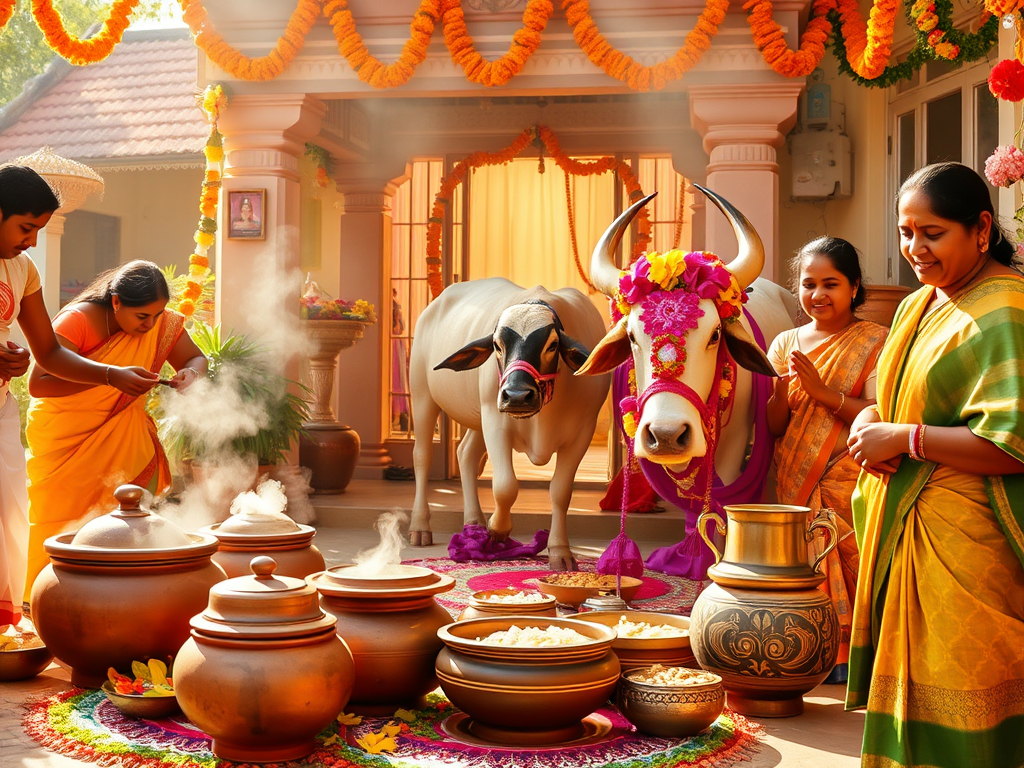
Day 2 – Surya Pongal (January 15): The main day of the festival is dedicated to the Sun God. Families prepare the traditional Pongal dish in clay pots, allowing it to boil over as a symbol of prosperity. This is the most important day of the celebration.
Day 3 – Mattu Pongal (January 16): This day honors cattle, particularly cows and bulls, who play a vital role in agriculture. Animals are bathed, decorated with flowers and painted horns, and worshipped for their service to farmers.
Day 4 – Kaanum Pongal (January 17): The final day is for family reunions and social visits. People gather to share meals, exchange gifts, and visit relatives. Young people seek blessings from elders, and communities come together in celebration.
Who: A Tamil Celebration with Universal Appeal
While Pongal is primarily celebrated by Tamil communities in Tamil Nadu and the union territory of Puducherry, the festival has a much broader reach. Tamil diaspora communities around the world—in Sri Lanka, Malaysia, Singapore, Mauritius, South Africa, Canada, the United States, and the United Kingdom—observe Pongal with equal fervor, maintaining their cultural connection to their homeland.
The festival transcends religious boundaries within Tamil society. Hindus form the majority of celebrants, but the agricultural and cultural significance of Pongal means that people of various faiths participate in the festivities. In rural areas, the celebration is particularly intense, as farming communities express gratitude for a successful harvest. Urban celebrations, while modernized, retain the core rituals and spirit of thanksgiving.
Pongal is celebrated by people of all ages and social classes. Farmers, who are at the heart of this harvest festival, conduct elaborate rituals in their fields and homes. Women play a central role in preparing the Pongal dish and creating intricate kolam designs, while children participate in traditional games and cattle races.
Why: Cultural, Agricultural, and Spiritual Significance
Pongal holds multifaceted significance in Tamil culture. At its core, it is a harvest thanksgiving festival that celebrates the end of the harvest season. After months of hard work in the fields, farmers express gratitude to the Sun God, rain, and the earth for a bountiful yield of rice, the staple crop of Tamil Nadu.
Agricultural Importance: The festival marks the Tamil harvest season when rice paddies are ready for reaping. Freshly harvested rice is used to prepare the ceremonial Pongal dish, symbolizing prosperity and abundance. The festival acknowledges the interdependence between humans, nature, and livestock in sustaining agricultural life.
Spiritual Significance: Pongal is dedicated to Surya, the Sun God, who provides the life-giving energy essential for crops to grow. The Sun’s northward journey (Uttarayana) is considered highly auspicious in Hindu tradition, representing the victory of light over darkness and the beginning of a six-month period of divine blessings. The festival also honors Indra (the rain god) and farm animals, recognizing the collective contribution of natural elements to human survival.
Cultural Identity: Pongal is deeply intertwined with Tamil identity and heritage. It represents the agrarian roots of Tamil civilization and serves as a reminder of the relationship between people and the land. The festival reinforces community bonds, family values, and respect for nature. Traditional folk arts, music, and dances associated with Pongal keep ancient Tamil culture alive across generations.
Social Harmony: The festival promotes equality and communal harmony. During Pongal, social hierarchies are temporarily dissolved as people from all walks of life come together to celebrate. The practice of sharing food with neighbors and feeding the less fortunate reflects the Tamil philosophy of annadanam (donating food) as the highest form of charity.
How: Celebrations and Traditions
Kolam Designs: One of the most visually stunning aspects of Pongal is the creation of kolam—intricate geometric patterns drawn on the ground in front of homes and temples. Women wake up early to clean the entrance and draw these designs using rice flour, colored powders, and flower petals. The patterns range from simple geometric shapes to elaborate depictions of flowers, birds, and deities. Kolam is believed to bring prosperity, welcome guests, and provide food for birds and insects. During Pongal, special kolam designs featuring the sun, pots, and sugarcane are created.
The Pongal Dish: The centerpiece of the celebration is the preparation of the traditional Pongal dish. On Surya Pongal, families gather outdoors in their courtyards or terraces to cook this sacred meal. A new clay pot is decorated with turmeric and vermillion, filled with freshly harvested rice, split mung lentils (moong dal), milk, and jaggery, and placed on a wood fire. As the mixture boils and overflows from the pot, everyone shouts “Pongalo Pongal!” (Let it overflow!), symbolizing abundance and prosperity. The sweet Pongal is first offered to the Sun God, then shared among family and neighbors. A savory version called Ven Pongal, made with rice, lentils, black pepper, and ghee, is also prepared.
Sugarcane and Traditional Offerings: Sugarcane stalks are an integral part of Pongal decorations. Homes are adorned with fresh sugarcane tied to doorways, symbolizing sweetness and prosperity. Traditional offerings to deities include turmeric plants, bananas, coconuts, betel leaves, and freshly harvested crops. These offerings express gratitude for the agricultural bounty.
Bhogi Bonfire: On Bhogi Pongal, old clothes, mats, and unwanted items are burned in a bonfire, symbolizing the destruction of the old and the welcoming of the new. This ritual represents purification and renewal. Young girls dance around the bonfire singing traditional folk songs.
Mattu Pongal Rituals: The third day is dedicated to cattle worship. Cows and bulls are bathed, their horns are painted in bright colors, flower garlands are placed around their necks, and they are fed Pongal and sugarcane. In rural areas, Jallikattu (bull-taming) events are organized, where young men attempt to hold onto a bull’s hump as it charges. Though controversial, Jallikattu is considered an ancient tradition showcasing bravery and is deeply rooted in Tamil culture. Cattle races and processions are also common.
Traditional Attire: People wear new clothes during Pongal, with women typically donning traditional silk sarees and men wearing veshti (dhoti) and shirts. The vibrant colors and traditional attire add to the festive atmosphere.
Folk Arts and Entertainment: Pongal celebrations include traditional Tamil folk dances such as Kummi and Kolattam, where women clap hands and dance in circles. Villagers perform Oyilattam, a dance with colorful scarves, and Mayilattam (peacock dance). Traditional music played on instruments like the nadaswaram and thavil fills the air. Storytelling, drama performances, and Uriyadi (a game where a pot filled with prizes is hung high and participants try to break it) provide entertainment.
Community Feasts: Families prepare elaborate meals featuring traditional dishes such as sakkarai pongal (sweet pongal), ven pongal (savory pongal), vadai (lentil fritters), payasam (sweet pudding), and various rice preparations. Meals are shared with neighbors, and community feasts bring people together in the spirit of unity and gratitude.
Conclusion
Pongal is far more than a harvest festival; it is a profound expression of Tamil culture, spirituality, and agrarian heritage. The four-day celebration encapsulates the values of gratitude, renewal, community, and respect for nature. From the vibrant kolam designs that adorn homes to the joyous cry of “Pongalo Pongal!” as rice boils over, every ritual carries deep symbolic meaning. Through honoring the Sun God, celebrating the harvest, worshipping cattle, and strengthening family bonds, Pongal represents the timeless connection between humanity and the natural world. As Tamil communities across the globe continue to celebrate this festival with enthusiasm, Pongal remains a living testament to the enduring spirit of Tamil civilization and its reverence for the elements that sustain life.
References
- Clothey, F. W. (2006). Ritualizing on the Boundaries: Continuity and Innovation in the Tamil Diaspora. Columbia: University of South Carolina Press.
- Hart, G. L., & Heifetz, H. (1999). The Four Hundred Songs of War and Wisdom: An Anthology of Poems from Classical Tamil. New York: Columbia University Press.
- Government of Tamil Nadu, Department of Tourism. (2023). “Pongal: The Harvest Festival of Tamil Nadu.” Available at: https://www.tamilnadutourism.tn.gov.in
- Mines, D. P., & Gourishankar, V. (1990). “Leadership and Individuality in South Asia: The Case of the South Indian Big-man.” Journal of Asian Studies, 49(4), 761-786.
- Rajagopal, A. (2014). “Pongal: Celebrating Tamil Identity and Agricultural Heritage.” Journal of Tamil Studies, 8(2), 45-62.
- Shanmugam, P. (2008). Tamil Culture and Civilization. Chennai: New Century Book House.
- Viswanathan, E. (2005). “Pongal: The Harvest Festival of Tamil Nadu.” Indian Folklife, 18, 12-14.
- Younger, P. (1995). The Home of Dancing Sivan: The Traditions of the Hindu Temple in Citamparam. New York: Oxford University Press.
- Zvelebil, K. (1973). The Smile of Murugan: On Tamil Literature of South India. Leiden: E.J. Brill.

 HABBA
HABBA 
Leave a comment